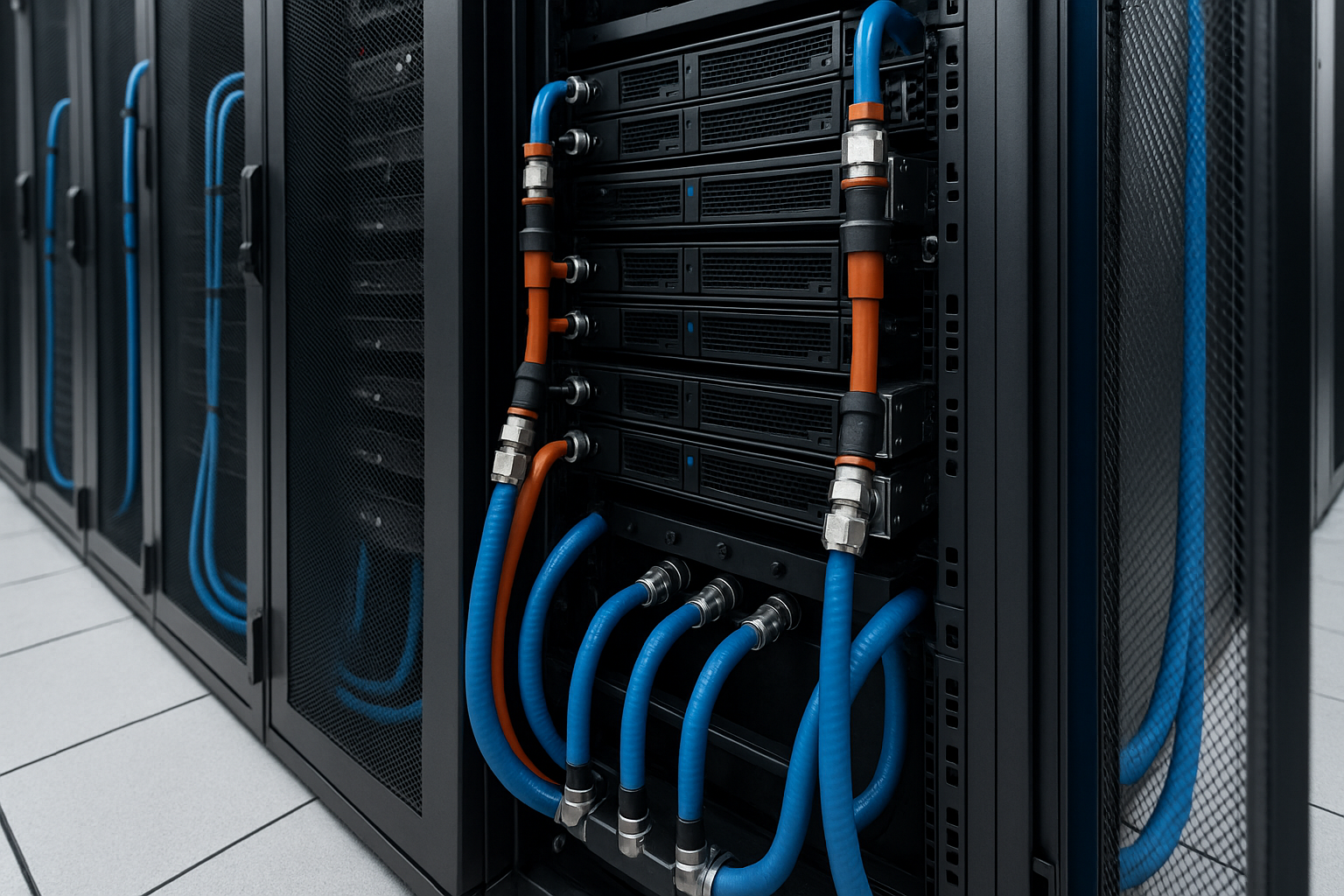
Introduction — Why It Matters
The rapid rise of AI-driven workloads and high-density racks is forcing a fundamental redesign of how data-centres are cooled. Traditional air-cooling systems are increasingly inadequate, and liquid cooling is no longer just a niche option — it's becoming a strategic necessity. Data Center Frontier+2Data Centers+2
What’s Driving the Shift
- Rising power densities: With racks approaching and exceeding 30 kW to 100 kW (and climbing toward 1 MW per rack) to support next-gen GPUs/AI hardware, the heat load is outpacing what air can handle. Techzine Global+2Data Centers+2
- Energy & sustainability pressure: Liquid cooling systems offer significant reductions in energy consumption, improve PUE (Power Usage Effectiveness), and open up opportunities for waste-heat reuse. DataCenterKnowledge+2STL Partners+2
- Space & layout constraints: Liquid cooling enables denser rack placement, smaller facility footprints, and more flexible site selection — especially important for edge/AI data centres. Data Centers+1
- Ecosystem maturity: What was once experimental is now gaining traction, with more vendors, standards, and use-cases supporting liquid cooling. TechMezine+1
Key Technologies & Approaches
- Direct-to-Chip (D2C) Cooling: Coolant circulates via cold-plates mounted directly on processors and other hot components — shortening thermal path and improving efficiency. Data Centers
- Immersion Cooling: Entire servers or server modules are submerged in non-conductive dielectric liquids; offers ultra-high thermal efficiency. DataCenterKnowledge+1
- Closed-Loop & Reuse Systems: Coolants and systems designed for high temperature reuse (e.g., hot-water loops used for district heating) are becoming more common. STL Partners+1
- Hybrid Cooling & Monitoring: Many data-centres are adopting hybrid air/liquid systems, plus AI-driven monitoring/optimisation to dynamically adjust cooling paths. Eziblank+1
Benefits & Business Case
- Higher thermal capacity per rack: Liquid cooling comfortably supports far higher heat loads than air (30–100 kW+ vs ~10–15 kW). Data Centers
- Reduced energy consumption: Less reliance on fans, chillers, large airflow volumes; better thermal conductivity means less wasted energy. Data Centers+1
- Smaller footprint & more flexible layouts: Enables denser equipment placement and even site conversions for edge or AI-specialist data centres. The Australian
- Improved sustainability metrics: Lower carbon footprint, potential to reuse waste heat, reduced water/air usage in some designs. Persistence Market Research
Challenges & Things to Watch
- Higher upfront cost & infrastructure changes: Retrofitting existing facilities for liquid cooling can be expensive and complex. Data Centers+1
- Operational complexity & maintenance: Liquid systems require specialized skills for pump/fluid management, leak detection, and redundancy design. Data Centers
- Vendor/standardisation maturity: Although improving, the ecosystem is less mature than traditional air-cooling systems — decisions must consider long-term support. TechMezine
- Site water/heat reuse and local regulations: The ability to reuse heat or manage fluid loops depends on location, local infrastructure and regulatory environment. STL Partners
Implications for Data-Centre Strategy (Especially for AI/High-Performance Workloads)
- If you’re designing or upgrading a facility to host AI/GPU clusters (for example, for generative AI, quantum simulation, or high-density HPC), you must evaluate liquid-cooling early in the design. Waiting until after layout/power decisions may be too late.
- Monitor fluid-cooling supply-chain developments (cold-plates, immersion tanks, coolant fluids, monitoring systems) — vendors are innovating rapidly. Electronic Design
- Consider modular architectures or edge deployments where liquid cooling allows placement in non-traditional locations (urban office-buildings, smaller sites) as part of an edge/AI strategy.
- If you’re in a region where waste-heat reuse is viable (district heating, industrial partners), liquid cooling creates the opportunity to turn thermal output into value, not just cost.
- From an educational/outreach perspective (which ties into your generative AI/quantum work), liquid cooling offers a compelling narrative: hardware design, thermal physics, infrastructure change — all underpinned by the explosion in AI workloads.
Conclusion
Liquid cooling has moved from “nice to have” to “must have” for modern data-centres. Driven by AI, high-density computing, sustainability mandates, and space/power constraints, the shift is well underway. While challenges remain — higher cost, infrastructure change, skills — the benefits around capacity, efficiency and flexibility are clear. For anyone designing next-generation computing facilities (or teaching about them), the message is that cooling strategy is no longer secondary — it’s central.