


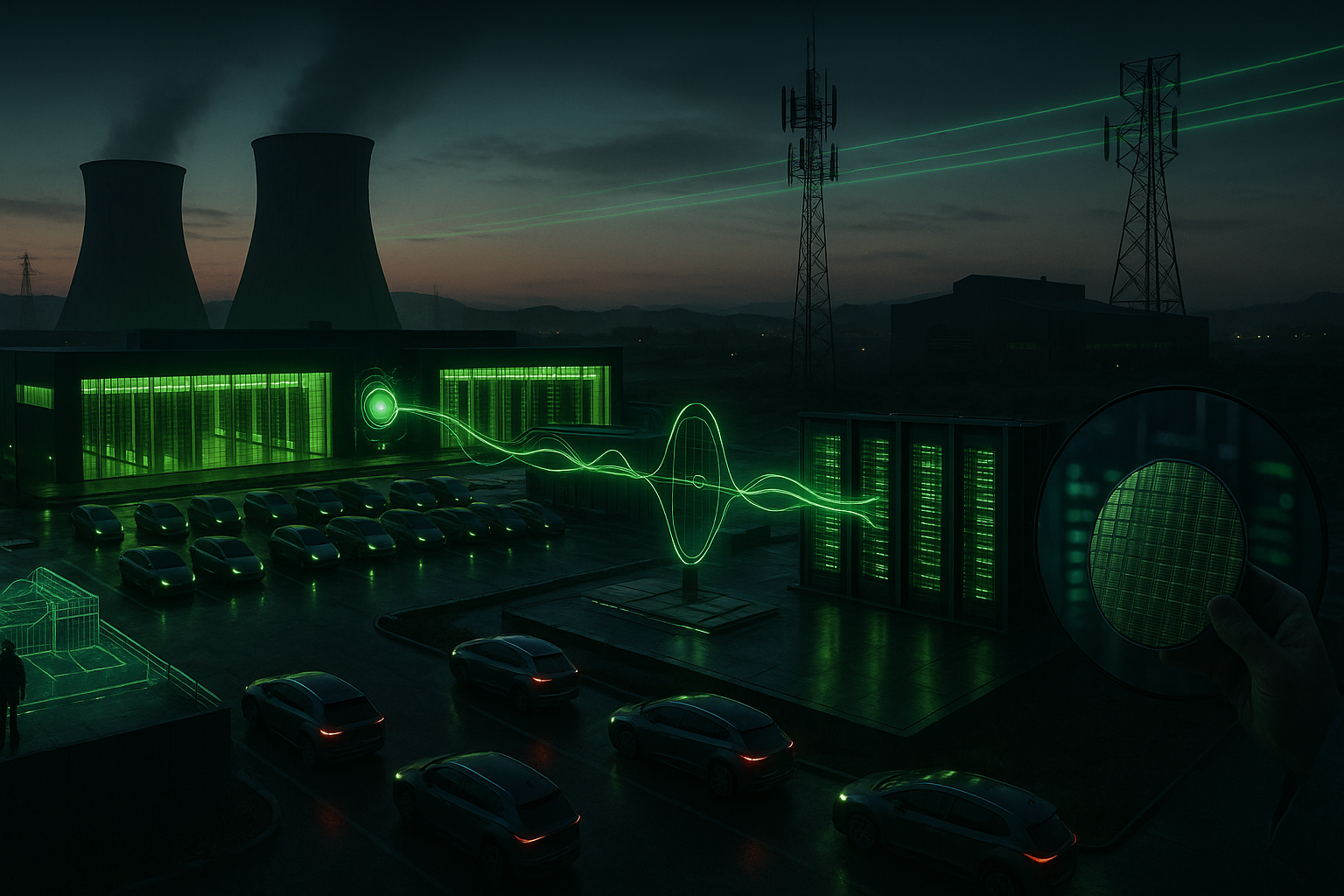
In a world saturated with daily AI headlines, it’s easy to become numb to the constant stream of announcements. Yet, every so often, a series of developments emerges that signals a fundamental shift, not just in technology, but in the very fabric of our industrial and scientific future. NVIDIA's recent GTC DC event was one of those moments, unveiling a blitz of initiatives with world-altering implications that go far beyond the typical news cycle.
The announcements spanned a breathtaking scope, from utility-scale "AI factories" and the future of 6G networks to a concrete plan for integrating quantum computers with today's supercomputers. While each is significant on its own, together they paint a picture of a company methodically building the full-stack infrastructure for what it calls "America’s next industrial and scientific renaissance."
These aren't just product updates; they are signposts indicating where the future is headed, revealing a strategy that is as surprising as it is ambitious.
Quantum Computers Aren't Replacing GPUs—They're Partnering With Them
For years, the prevailing narrative has been that quantum computers would one day render classical processors like GPUs obsolete. NVIDIA’s latest announcements offer a powerful counter-narrative, reframing the future as a symbiotic partnership rather than a replacement. The key to this vision is NVQLink, introduced as the "world's first quantum interconnect."
The core problem NVQLink solves is a fundamental weakness of quantum computing: qubits, the basic units of quantum information, are incredibly delicate and error-prone. They require constant supervision, calibration, and error correction from powerful classical computers to function correctly. Think of the Quantum Processing Unit (QPU) as a brilliant but chaotic artist, and the GPU as the disciplined studio manager, constantly providing the tools, correcting mistakes, and keeping the entire project on track. NVQLink is an open architecture designed to tightly couple these two roles, and the initiative is already backed by 17 quantum hardware companies and nine U.S. national labs, signaling broad industry adoption.
As Tim Costa, NVIDIA's general manager for quantum, articulated at the GTC DC event, this collaboration is foundational:
"Every supercomputer will draw on quantum processors to expand the problems it can compute, and every quantum processor will rely on a supercomputer to run correctly. GPUs act as the brains that orchestrate the quantum hardware."
This signals a strategic re-framing of the quantum roadmap. It positions GPUs not as a bridge technology waiting to be replaced, but as an essential, permanent component of the quantum future. The takeaway is clear: the path to fault-tolerant quantum computing runs directly through high-performance classical computing.
"AI Factories" Are Becoming Gigawatt-Scale Infrastructure
NVIDIA is pushing the concept of the "AI Factory" far beyond a simple metaphor. The clear implication here is that NVIDIA is redefining AI data centers as a new class of public utility, on par with the power plants that fueled the last industrial revolution. The immense energy consumption of AI is a looming challenge, and NVIDIA is strategically positioning itself as the architect of the power grid for the AI age.
The company unveiled Omniverse DSX, a "blueprint for gigawatt-scale AI campuses" establishing a common architecture for facilities ranging from 100 megawatts to multiple gigawatts. Using the Omniverse platform, engineers can build and test these massive facilities as "digital twins"—perfect virtual replicas that obey real-world physics, allowing engineers to simulate everything from airflow and cooling efficiency to structural integrity before a single shovel of dirt is moved. Underpinning this is new hardware like the BlueField-4 DPU, designed to accelerate the underlying networking and security fabric of these massive facilities.
Major partnerships are already bringing this vision to life. The U.S. Department of Energy (DOE) and Oracle are collaborating with NVIDIA to build two large-scale AI factories. The first, "Equinox," will support 10,000 GPUs, while the follow-on "Solstice" project will deliver a staggering 2,200 exaflops of AI performance.
The Scale of the Next Chip Generation Is Mind-Boggling
While the announcement of a new chip generation is always expected from NVIDIA, the production and revenue numbers associated with its next wave of technology are staggering. The figures revealed by CEO Jensen Huang signal a level of demand and manufacturing scale that is almost difficult to comprehend.
Huang disclosed that NVIDIA expects to ship 20 million Blackwell chips. To put that in perspective, the entire lifecycle of the previous-generation Hopper architecture saw only 4 million units shipped. Furthermore, the company anticipates that the Blackwell and subsequent Rubin chip generations will collectively generate a combined $500 billion in GPU sales over just five quarters. Adding another significant dimension to this scale-up, the Blackwell GPU has now officially entered full production in Arizona, a major milestone for U.S.-based advanced semiconductor manufacturing.
The subtext of these production numbers is a strategic play to saturate the market and build an inescapable ecosystem. A five-fold increase in production isn't just about meeting demand; it's a move to lower the barrier to entry for building on NVIDIA's platform, ensuring the entire next generation of AI development is architecturally dependent on their hardware. It’s a shift from just selling shovels to building the entire gold rush town.
A Global Robotaxi Fleet Is Arriving Sooner Than You Think
Amidst the high-level infrastructure announcements, NVIDIA also revealed a plan for one of the most tangible, real-world applications of its technology: a massive, global fleet of autonomous robotaxis. This isn't a distant dream or a small-scale pilot; it's a concrete deployment plan with a clear timeline that moves autonomous ride-hailing out of the realm of isolated experiments and onto a path for large-scale global deployment.
NVIDIA announced a global partnership with Uber Technologies Inc. to deploy a fleet that will fundamentally change urban mobility. The scale of the ambition was laid bare by Kari Briski, vice president of generative AI software at Nvidia:
"Together, we’ll deploy more than 100,000 robotaxis worldwide in the next few years."
Uber plans to begin scaling its fleet to 100,000 units starting in 2027, leveraging NVIDIA's DRIVE AGX Hyperion 10 platform. The L4-ready vehicles will be produced by major automotive manufacturers, including Stellantis (the parent company of Chrysler), Lucid Group, and Mercedes-Benz Group, signaling that the autonomous vehicle revolution is much closer than many believed.
Your Phone Network Is Evolving into an AI Platform
NVIDIA's foray into 6G is less about speed and more about fundamentally re-architecting how global networks evolve, aiming to turn costly, multi-year hardware overhauls into simple software updates. This positions the world’s telecommunications grid as a distributed cloud computing platform for AI.
A key partnership with Nokia will create an "AI-native wireless stack" built on NVIDIA's Aerial platform. This offers a revolutionary benefit to carriers: the ability to upgrade their networks from 5G to 6G using software alone, powered by the NVIDIA Aerial RAN Computer Pro (ARC Pro). AI is now integral to the emerging 6G standard, which is expected to be up to 1,000 times faster than 5G and will be essential for powering next-generation technologies like autonomous vehicles and augmented reality glasses. T-Mobile is already on board to test the technology, with trials expected to begin in 2026.
Taken together, these five takeaways illustrate a cohesive and audacious strategy. This is the story of NVIDIA's deliberate evolution from a component supplier (selling GPUs), to a platform provider (CUDA, Omniverse), and now to an infrastructure architect designing the gigawatt-scale factories and quantum-classical operating models of the future. The company is positioning itself not just as a participant in the AI revolution, but as its primary industrial planner.
As CEO Jensen Huang stated, "AI is the most powerful technology of our time, and science is its greatest frontier." The recent announcements provide a clear blueprint of how NVIDIA plans to conquer that frontier. It leaves us with a profound question to ponder: As AI becomes as fundamental as electricity, what part of our world will remain untouched by this new industrial revolution?

The sources provided are:
1. Excerpts from "Inside Nvidia's GTC DC announcements: From AI factories to quantum computers and 6G networks - SiliconANGLE"
2. Excerpts from "Key Takeaways from Jensen Huang's GTC Speech at NVIDIA: Major Collaborations Including 6G, NVQLink Connecting Quantum Computing, Rebuttal of AI Bubble Concerns, and Blackwell Made in the USA"
3. Excerpts from "NVIDIA Introduces NVQLink — Connecting Quantum and GPU Computing for 17 Quantum Builders and Nine Scientific Labs | NVIDIA Newsroom"
4. Excerpts from "NVIDIA Launches NVQLink to Bridge Quantum and Classical Supercomputing"
5. Excerpts from "NVIDIA's NVQLink Unites Quantum Ecosystem for Real-Time Error Correction"
6. Excerpts from "Nvidia and Alice & Bob unveil NVQLink to tighten GPU–quantum integration - R&D World"
7. Excerpts from "Quantum entanglement - Wikipedia"
8. Excerpts from "Quantum network - Wikipedia"
9. Excerpts from "Scale Quantum Processing Unit Development With NVIDIA NVQLink"
10. Excerpts from "Superconducting quantum computing - Wikipedia"
11. Excerpts from "Trapped-ion quantum computer - Wikipedia"
